Visium / Visium HD - 10x
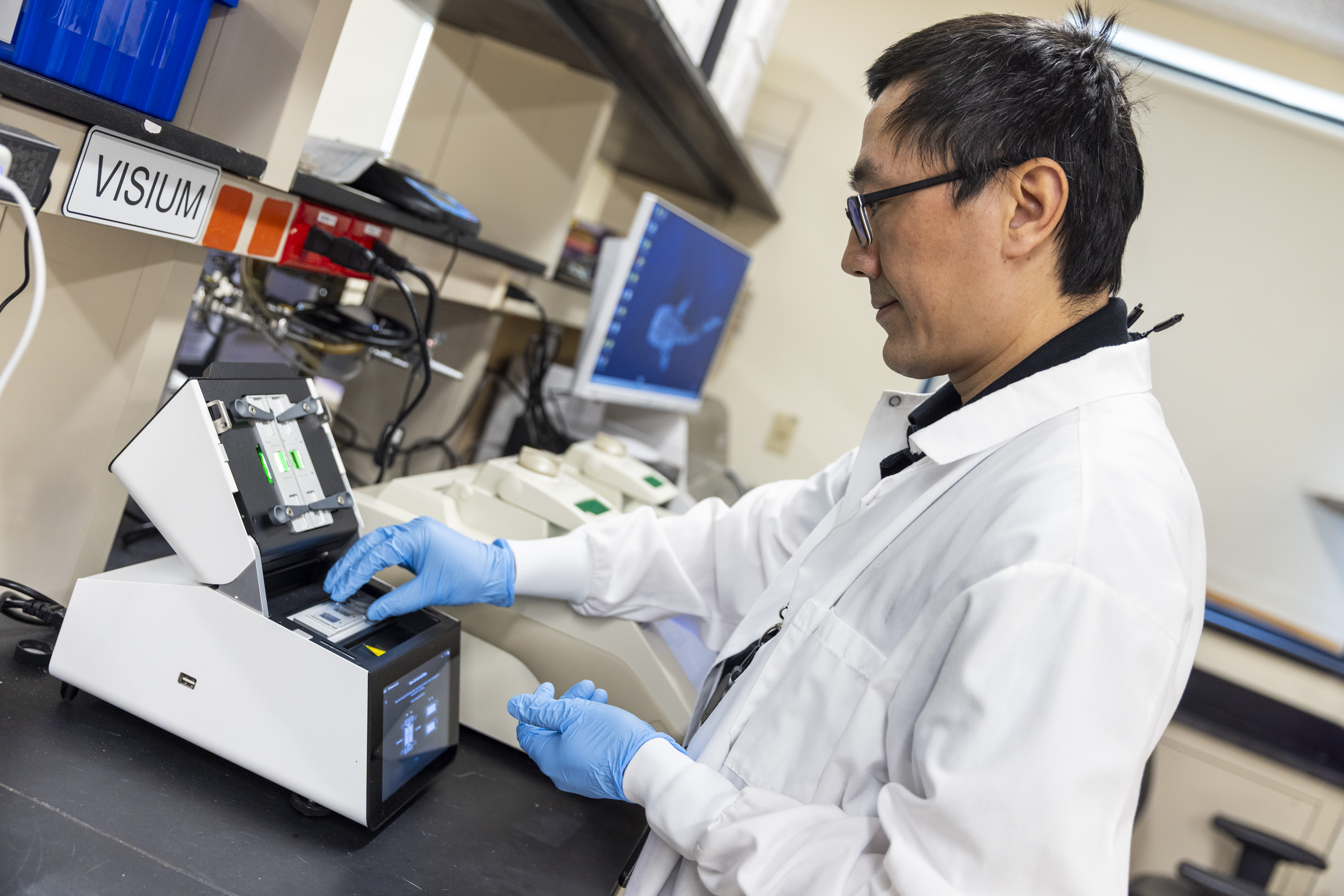
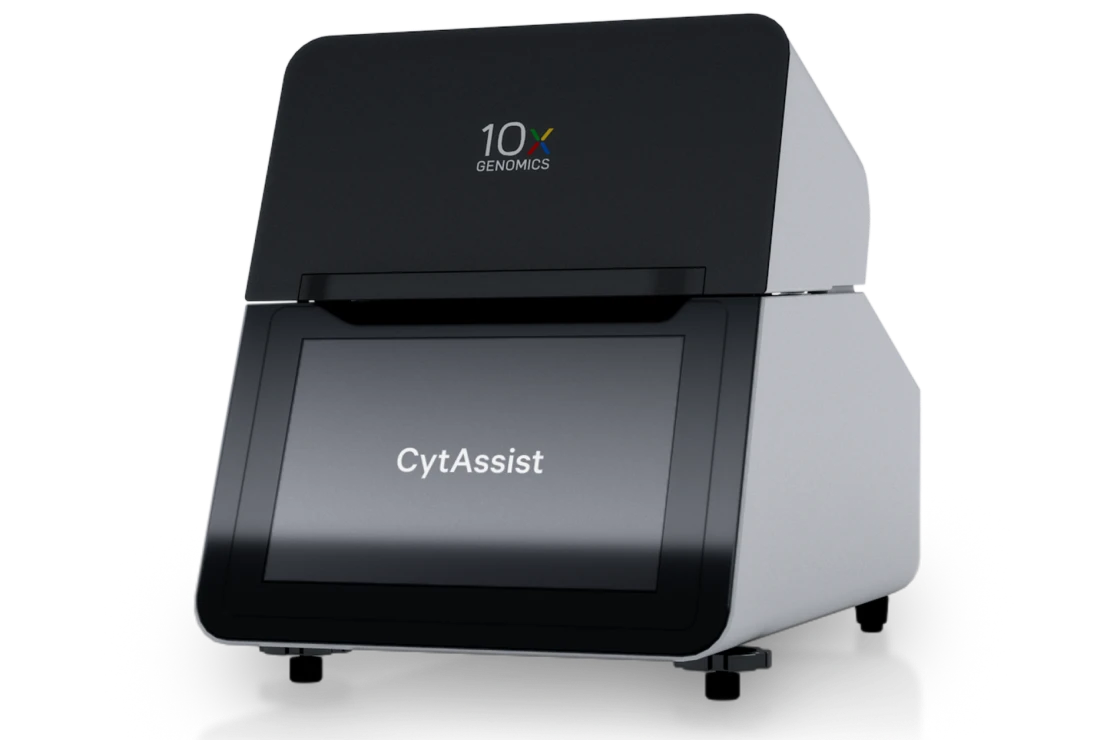
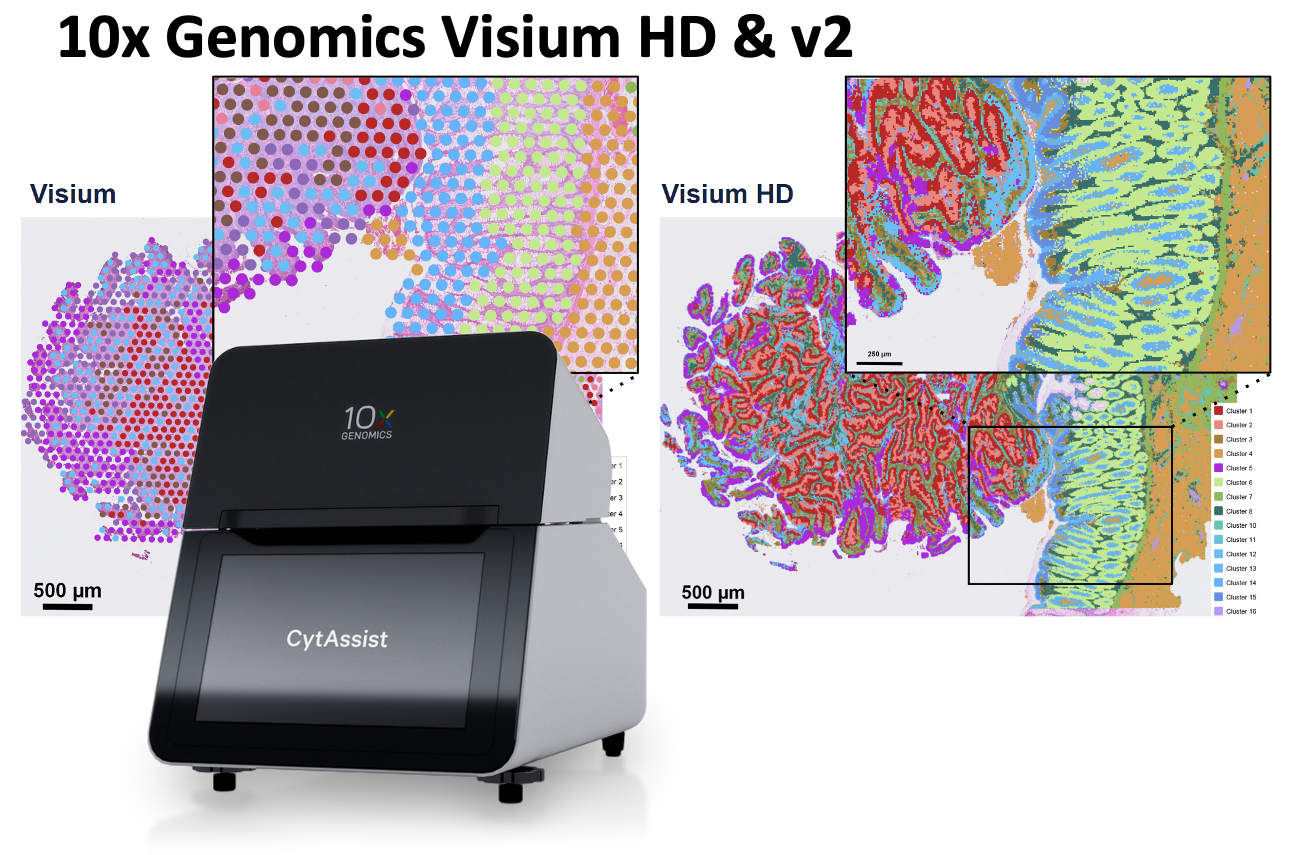
Visium is a sequencing-based spatial gene expression platform from 10x Genomics that maps whole-transcriptome expression across an intact tissue section while preserving spatial context. A tissue section is placed on, or transferred by the Visium CytAssist instrument onto, a barcoded capture slide; captured transcripts are converted to Illumina-compatible libraries and sequenced, then mapped back to the tissue image. Two resolution formats are offered: standard Visium with 55 um barcoded spots, and Visium HD with a continuous lawn of 2 um barcoded squares for single cell-scale resolution. Probe-based chemistry supports human and mouse; poly(A) capture chemistry is species agnostic.
Specification
| Vendor | 10x Genomics |
|---|---|
| Modality | sequencing-based spatial transcriptomics |
| Tissue | probe variants FFPE and fresh frozen; polyA variants fresh frozen |
| Dimensions | 6.5 x 6.5 mm, 11 x 11 mm |
| Resolution | HD 2 um; v2 and direct placement 55 um |
| Species | probe variants (HD probes, v2, v2+protein) human and mouse; polyA variants (HD 3', direct placement) any |
| Minimum | 2 capture areas (one slide, always 2) |
| Billing | capture_area |
Accreditations & experience
The Spatial Technologies Unit is an accredited service provider and among the first facilities worldwide certified through 10x Genomics' Core Lab Training program. See the Accreditations page.
Coverage and chemistries
Visium measures the whole transcriptome rather than a fixed target panel; the choice is the capture chemistry and resolution format.
- Standard Visium (CytAssist, 55 um spots): probe-based whole-transcriptome capture for human and mouse. The CytAssist instrument transfers probes from a routine H&E- or IF-stained glass slide onto the barcoded Visium slide.
- Direct-placement Visium (55 um spots): the original 3' poly(A) capture chemistry, species agnostic, with the section placed directly on the capture slide.
- Probe-based chemistry (human, mouse) versus poly(A) capture (species agnostic) is the determinant of species support.
Visium HD
Visium HD provides the high-resolution tier. Each HD Capture Area is a continuous lawn of oligonucleotides arrayed in ~11 million 2 x 2 um barcoded squares without gaps, achieving single cell-scale spatial resolution. Data are output at 2 um and provided at multiple bin sizes; the 8 x 8 um bin is the recommended starting point for visualization and analysis.
- Probe-based HD chemistry supports human and mouse (whole transcriptome).
- A 3' poly(A) HD chemistry is species agnostic.
Visium HD (3') is available for fresh-frozen tissue only.
Multi-omics
Visium CytAssist Spatial Gene and Protein Expression measures whole-transcriptome RNA and protein simultaneously on the same FFPE section using oligo-conjugated antibodies. The pre-designed Human Immune Cell Profiling Panel is a 35-plex antibody panel targeting intracellular and extracellular antigens, with four isotype controls for normalization; additional custom oligo-conjugated antibodies can be added to the panel.
Additional capabilities
The tissue is imaged by standard histology before capture: H&E or immunofluorescence staining and imaging are performed on the section, and the CytAssist workflow allows routine glass slides to be used for sectioning, staining and imaging before probe transfer. This permits region selection on the histology image prior to spatial profiling.
What you receive
- FASTQ files and raw count matrices
- Space Ranger outputs: filtered and raw feature-barcode matrices
- spatial folder (tissue image, scale factors, barcode positions)
- high-resolution H&E or IF image and Loupe Browser file (.cloupe)
- web-summary QC report; MD5 checksums at transfer
Access and priority
Internal clients (BIDMC, DF/HCC), external academic and non-profit clients, and industry clients all have equal priority. Projects begin upon sample receipt.