
GEM-X 3'/5'
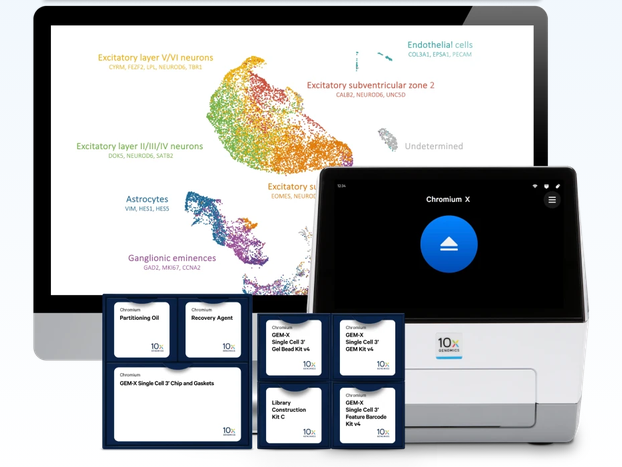
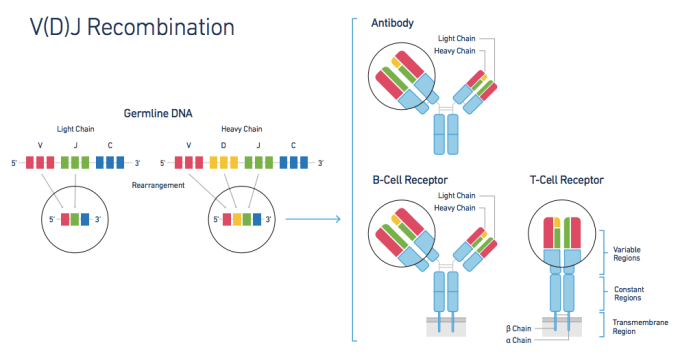
GEM-X Single Cell Gene Expression is a droplet-based single-cell platform from 10x Genomics that profiles the whole transcriptome of individual cells or nuclei. Cells are partitioned into gel bead-in-emulsion (GEM) droplets on a Chromium X-series instrument, barcoded, and converted to Illumina-compatible libraries. The 3' assay reads transcripts from the 3' end; the 5' assay reads from the 5' end and additionally supports paired full-length T- and B-cell receptor (V(D)J) sequencing. Both assays support whole-transcriptome coverage across a wide range of species by reverse-transcription chemistry.
Specification
| Vendor | 10x Genomics |
|---|---|
| Modality | single cell and nucleus transcriptomics |
| Tissue | fresh, frozen |
| Input | Single-cell or single-nuclei suspensions; the 3' and 5' assays cannot take FFPE |
| Cells per sample | 500-20,000 cells per sample (GEM-X 3'/5' v4) |
| Chip capacity | 1-8 samples per chip; up to 160,000 cells per chip (singleplex, ~20,000 cells/sample, up to 80% recovery) |
| Species | any |
| Minimum | 1 sample |
| Billing | sample |
Accreditations & experience
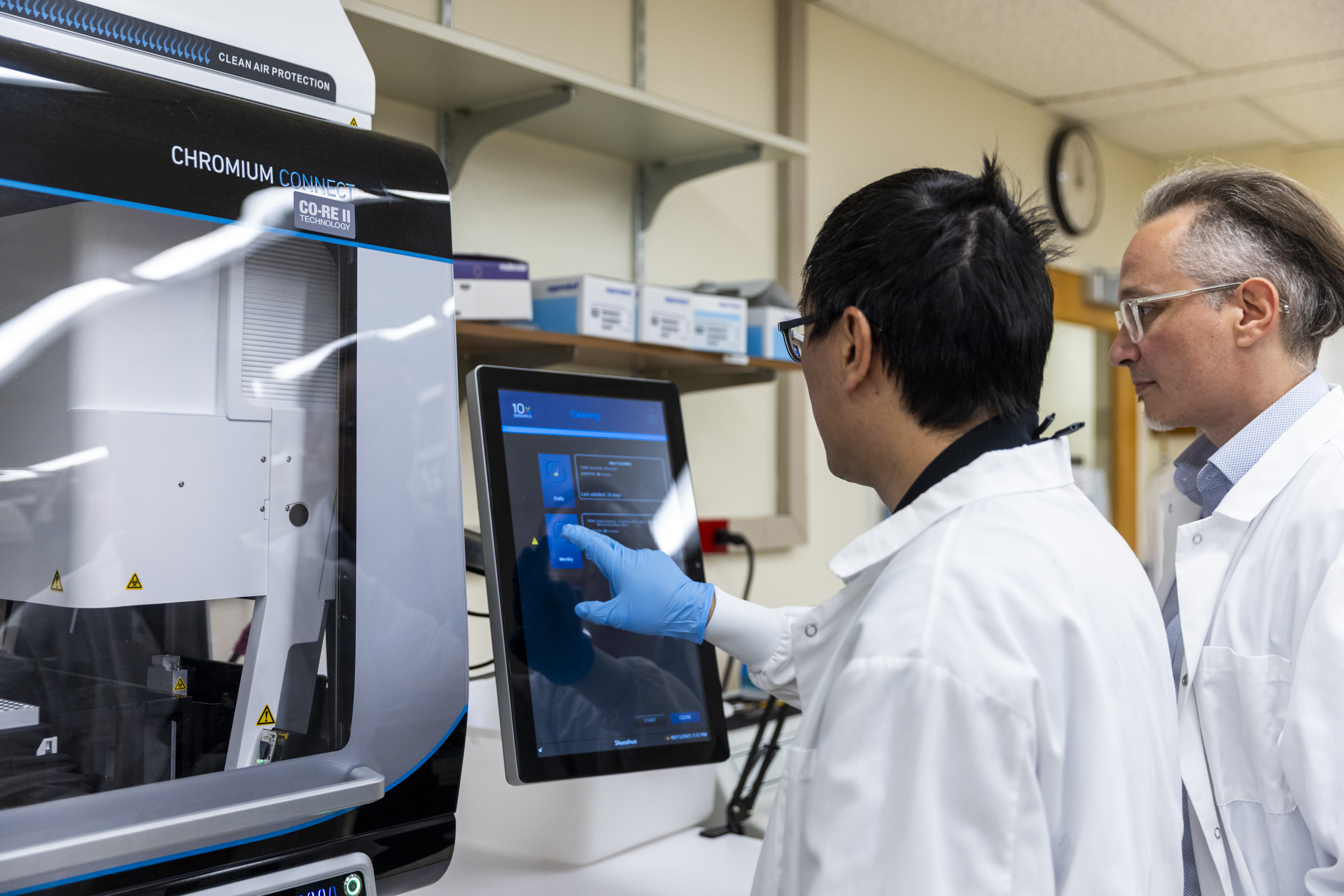
The Spatial Technologies Unit is an accredited service provider and among the first facilities worldwide certified through 10x Genomics' Core Lab Training program. See the Accreditations page.
Coverage
GEM-X provides whole-transcriptome single-cell gene expression, not a fixed target panel.
- 3' Gene Expression: reverse-transcription chemistry reading the 3' end of transcripts; species agnostic.
- 5' Gene Expression: reads the 5' end and enables paired immune-repertoire profiling on the same cells.
- Throughput per sample: 500-20,000 cells (or nuclei).
Multi-omics
GEM-X runs additional readouts from the same partitioned cells via Feature Barcode technology.
- Cell surface protein: oligo-conjugated antibodies measured alongside gene expression (available on 3' and 5').
- CRISPR screening: guide RNA capture read out with the transcriptome.
- Immune profiling (5' only): full-length, paired TCR and BCR (V(D)J) sequences for human and mouse, with optional antigen-specificity profiling.
- The STU offers TCR and BCR enrichment and cell-surface-protein (CITE-seq-type) library preparation as add-ons.
On-chip multiplexing (OCM)
On-Chip Multiplexing (OCM) is a sample-multiplexing mode of the GEM-X Universal assay. Up to four samples, each loaded with a distinct barcoded gel-bead set, are co-partitioned on one GEM-X chip and demultiplexed computationally after sequencing, with no upstream cell-tagging step. OCM produces the same whole-transcriptome single-cell data as the standard 3' and 5' assays and buys sample throughput rather than cell depth.
- Up to 4 samples per multiplexing set (one recovery well); up to 8 per chip (two sets of 4).
- Cells per sample: 500-5,000; up to about 40,000 cells per chip.
- Compatible kits: GEM-X Universal 3' v4 and 5' v3; minimum order 8 samples; sequencing included at the recommended depth.
Sample preparation
GEM-X accepts single-cell or single-nuclei suspensions. Nuclei isolation is offered as a preparation service for fresh-frozen and for FFPE material.
What you receive
- FASTQ files and raw count matrices
- Cell Ranger outputs: filtered and raw feature-barcode matrices
- cDNA and library electropherograms and quantification metrics
- Loupe Browser file (.cloupe) and web-summary QC report
- MD5 checksums at transfer
Access and priority
Internal clients (BIDMC, DF/HCC), external academic and non-profit clients, and industry clients all have equal priority. Projects begin upon sample receipt.