B2B and strategic partnership options
The Spatial Technologies Unit works with industry partners, non-profit organizations, multi-institutional consortia, and academic departments across the United States under long-term strategic alliances. These arrangements go beyond per-project service work. An alliance establishes a sustained relationship in which workflows are tailored to a partner's programs, capacity is planned in advance, and per-sample costs decrease as volume and scheduling predictability increase.
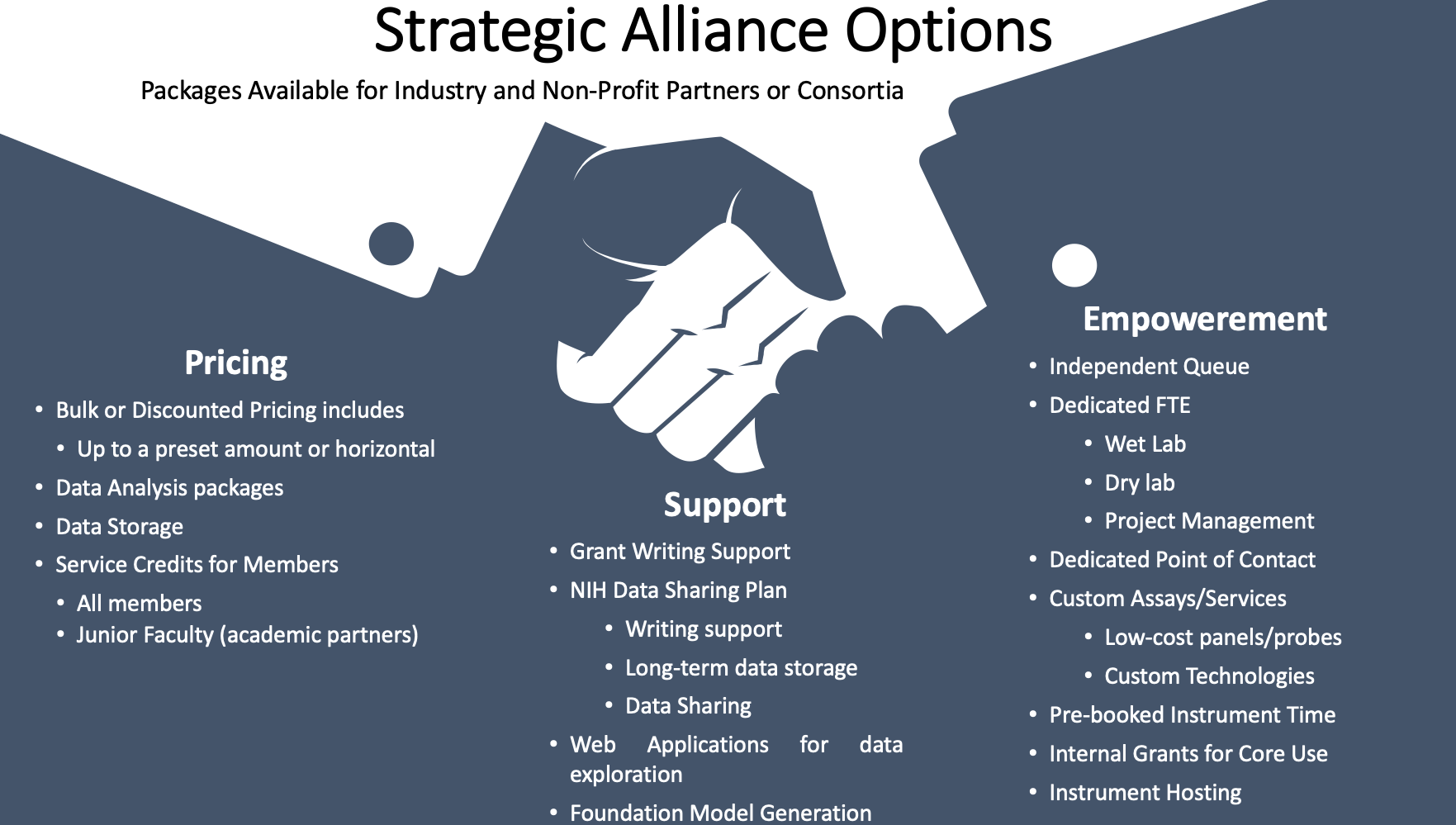
Each alliance is negotiated to the partner's scope and duration and is built around three areas: preferential pricing, scientific and regulatory support, and dedicated operational capacity. The sections below describe what each area can include; specific terms are set per agreement.
Pricing
Long-term commitments unlock bulk and discounted rates against the published catalogue, applied up to a preset volume or across a defined portfolio of services. Alliance pricing extends to data-analysis packages and long-term data storage, and can include service credits for members - available to all members, with additional allocations for junior faculty at academic partners.
Support
Partners gain access to the unit's scientific and regulatory support beyond the bench:
- Grant-writing support for the spatial and single-cell components of applications.
- NIH Data Sharing Plan support - drafting the plan, long-term data storage, and managed data sharing.
- Web applications for interactive data exploration, delivered with the processed data.
- Foundation-model generation on partner datasets.
- Training and education for partner staff, from assay selection and experimental design through downstream analysis.
Empowerment
For partners that require guaranteed capacity, an alliance can provision dedicated resources:
- An independent sample queue, separate from the general service queue.
- Dedicated FTE across the wet lab, the dry lab (analysis), and project management.
- A dedicated point of contact.
- Custom assays and services, including low-cost panels and probes and access to custom technologies.
- Pre-booked instrument time, internal grants for core use, and instrument hosting.
Establishing a partnership
Partnerships begin with a scoping consultation, which is free of charge. We map your program's assays, sample volumes, timelines, and data needs to the appropriate combination of the options above, then propose terms. To start the conversation, contact the unit.