
Flex
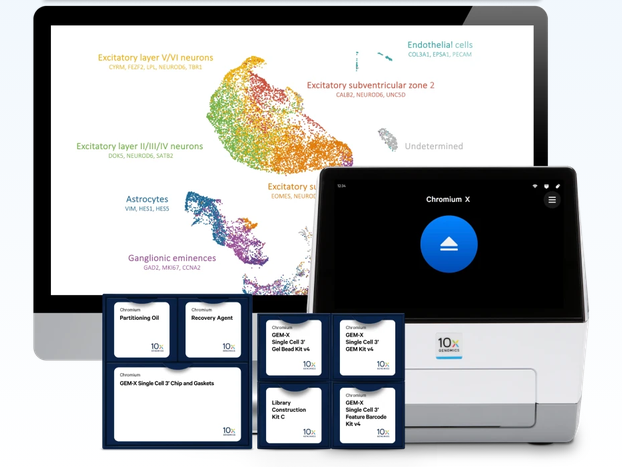
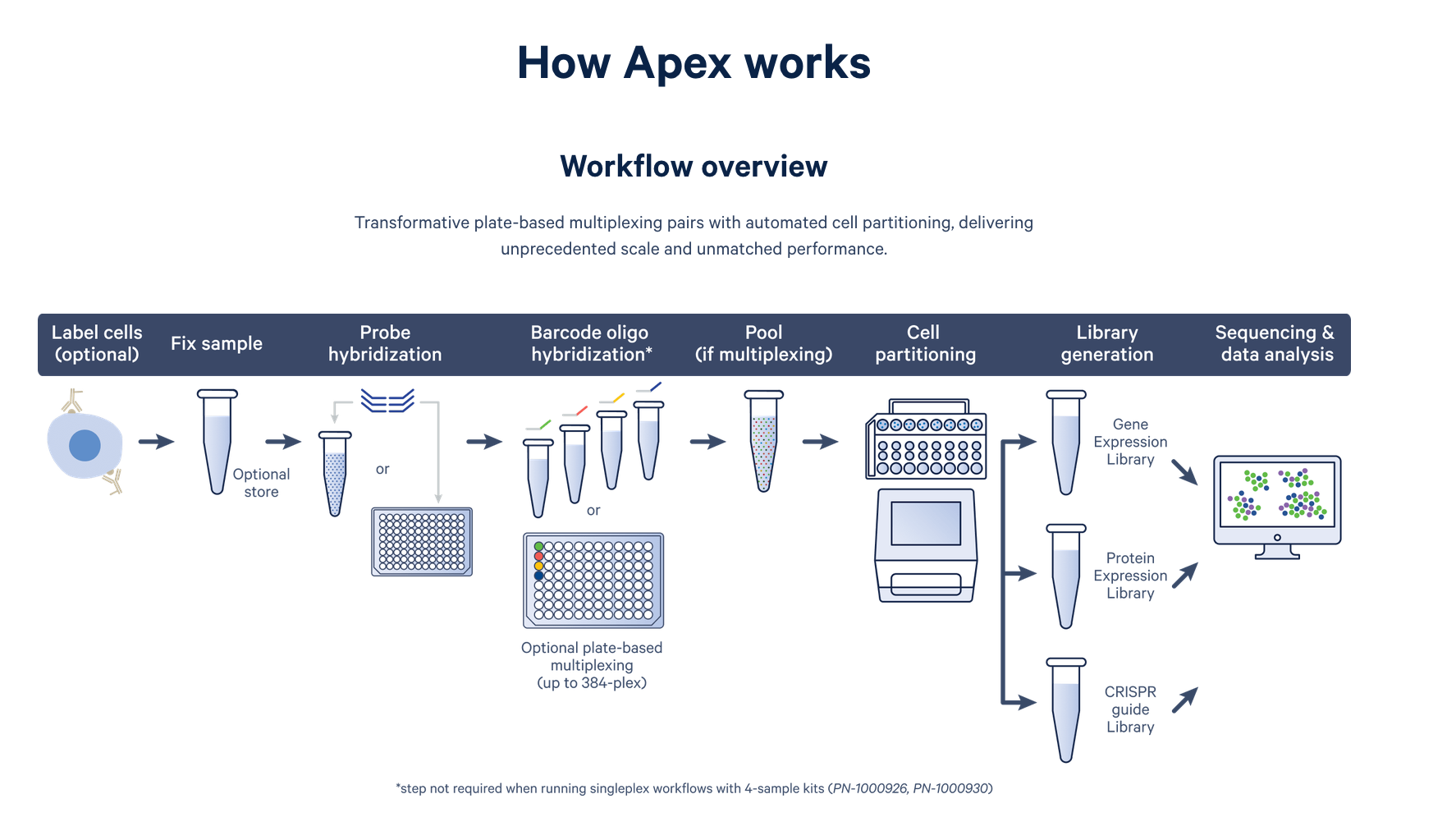
Flex (Fixed RNA Profiling) is a probe-based single-cell gene expression assay from 10x Genomics for fixed cells and nuclei, including formaldehyde-fixed material and FFPE tissue. Pairs of sequence-specific probes hybridize to protein-coding transcripts and are ligated in gel bead-in-emulsion droplets on the Chromium platform, then barcoded and sequenced on Illumina instruments. Because probes target defined transcripts, the assay is run with fixed human, mouse, or rat probe sets and covers protein-coding genes only. Barcoded probes allow multiple samples to be pooled into a single hybridization reaction. A high-throughput plate-based mode, Apex, scales the same probe chemistry with automated cell partitioning to up to 384 samples per run.
Specification
| Vendor | 10x Genomics |
|---|---|
| Modality | single cell and nucleus transcriptomics, probe-based |
| Tissue | fresh (fixed), frozen, FFPE |
| Input | Fresh, frozen, or FFPE tissue; unfixed/fresh or cryopreserved cells |
| Cells per sample | 20000 cells |
| Chip capacity | up to 384 samples per run with Apex plate-based multiplexing |
| Multiplexing | 1, 4, 8, or 16 (standard); up to 384 with Apex |
| Species | human, mouse |
| Minimum | 1 sample; 16-plex minimum 16; plate-based fixation minimum 96 |
| Billing | sample |
Accreditations & experience
The Spatial Technologies Unit is an accredited service provider and among the first facilities worldwide certified through 10x Genomics' Core Lab Training program. See the Accreditations page.
Coverage
Flex uses fixed whole-transcriptome probe sets rather than a target panel or an open capture chemistry.
- Human probe set: targets a maximum of ~18,082 genes.
- Mouse probe set: targets a maximum of ~19,059 genes.
- A rat probe set is also available from the vendor.
- Each probe is a pair of oligonucleotides that hybridize to the target transcript and are ligated; only protein-coding genes included in the probe set are detected. Non-coding transcripts, isoforms, SNVs and V(D)J sequences are not recovered by this chemistry.
High-throughput multiplexing (Apex)
Apex is the plate-based, high-throughput mode of Flex, not a separate product: the same probe chemistry paired with automated cell partitioning, scaling multiplexing to up to 384 samples in a single run. Gene expression, cell-surface and intracellular protein, and CRISPR guide libraries can be generated. 10x offers Apex within the Flex product line.
Multi-omics
On the GEM-X Flex / Apex chemistry, additional readouts can be captured alongside gene expression: cell surface protein, intracellular protein, and CRISPR guides.
Additional capabilities
Fixation locks the transcriptional state at collection and allows samples to be stored and batched before processing, decoupling sample collection from library preparation. The assay processes FFPE blocks as well as freshly fixed cells and nuclei; a single-nucleus workflow for FFPE (snPATHOseq) is used at the STU for FFPE input. The unit offers Flex Apex for whole-blood single-nucleus RNA-seq (snRNA-seq).
What you receive
- FASTQ files and raw count matrices
- Cell Ranger outputs: filtered and raw probe-barcode matrices
- cDNA and library electropherograms and quantification metrics
- Loupe Browser file (.cloupe) and web-summary QC report
- MD5 checksums at transfer
Access and priority
Internal clients (BIDMC, DF/HCC), external academic and non-profit clients, and industry clients all have equal priority. Projects begin upon sample receipt.